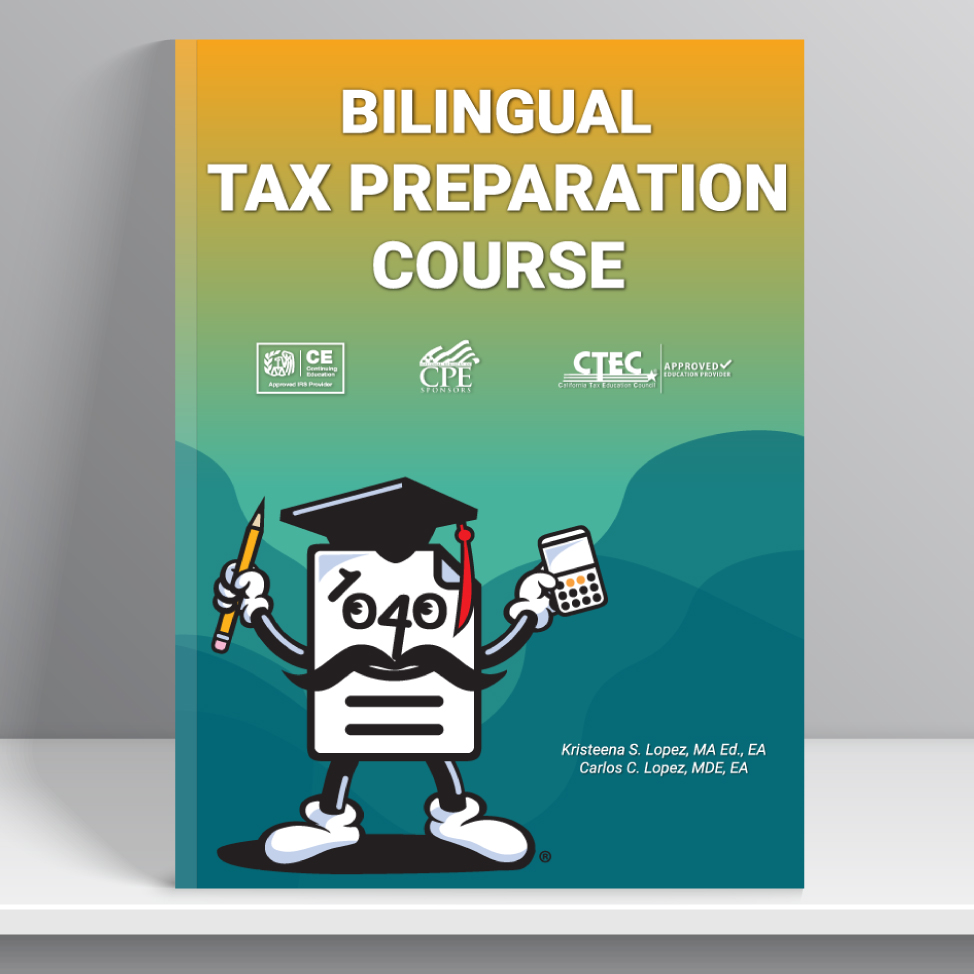
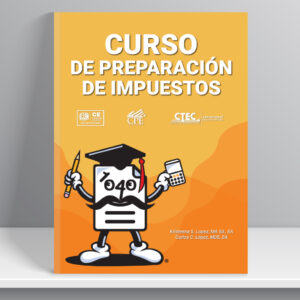
Bilingual Tax Preparation Course

CE Credits: 10 Federal Tax Law · 3 Federal Tax Updates · 2 Regulatory Ethics

A beginner tax preparer course that walks you through preparing a federal individual return (Form 1040) from start to finish. No experience required, fully self-study, at your own pace.

In this course you will learn:

  • How to prepare a federal individual tax return
  • How to determine filing status and which forms to use
  • Which credits the taxpayer qualifies for
  • How to apply the 2026 tax law changes under the OBBBA

$346.00

- +

Description

CE Credits
10 Federal Tax Law  ·  3 Federal Tax Updates  ·  2 Regulatory Ethics

The 2026 Tax Preparation Course is designed to give you the knowledge you need to meet IRS requirements and build a solid understanding of tax law and practice, so you can serve your clients with confidence. The material is organized to give line-by-line instructions for Form 1040, and it includes the latest 2026 tax law changes from the One Big Beautiful Bill Act (OBBBA).

What you’ll be able to do

  • Identify the correct filing status and determine qualifying dependents
  • Report income, adjustments, and capital gains and losses
  • Apply the standard and itemized deductions accurately
  • Calculate payments, tax credits, and taxpayer penalties
  • Complete Schedule C, Schedule E, and Schedule 2
  • Handle extensions, amendments, and e-filing
  • Safeguard taxpayer documents and information
  • Apply ethical standards in your tax practice

How this course works

Our online training system combines traditional textbook lessons with interactive questions and Practice Tax Returns (PTRs). Each chapter builds on the one before it. After each chapter you complete a Practice Tax Return along with its own set of review questions.

Practice Tax Returns are provided in PDF format and include links to the forms you need to complete a return by hand. Returns that include Schedule A are prepared with state income tax withholding on line 5, along with any applicable state-specific taxes. Each PTR is based on the material covered in its chapter.

Course chapters

  1. Overview of Form 1040. Get familiar with the main individual tax return, including its structure, sections, and how it fits together.
  2. Filing status, dependents, and deductions. Learn how to determine the right filing status, who qualifies as a dependent, and how to choose between the standard and itemized deductions.
  3. Income. Understand the types of taxable income, from wages and tips to interest and dividends, and where each belongs on the return.
  4. Adjustments to income. Discover above-the-line deductions like student loan interest and IRA contributions that reduce taxable income.
  5. Other taxes and taxpayer penalties. Learn about additional taxes such as self-employment tax, and the penalties taxpayers may face for underpayment or late filing.
  6. Payments and tax credits. See how withholding, estimated payments, and credits like the Child Tax Credit and EIC reduce what a taxpayer owes.
  7. Itemized deductions. Work through Schedule A deductions including mortgage interest, medical expenses, and charitable contributions.
  8. Capital gains and losses. Learn how to report gains and losses from selling stocks, real estate, and other assets, and how the tax rates apply.
  9. Depreciation. Understand how to deduct the cost of business assets over time using methods like Section 179 and bonus depreciation.
  10. Schedule C. Report business income and expenses for self-employed individuals and sole proprietors on the personal return.
  11. Schedule E. Cover supplemental income from rental properties, partnerships, S corporations, and trusts.
  12. Extensions, amendments, and electronic filing. Learn how to file Form 4868 for an extension, correct a return with Form 1040-X, and navigate e-filing options.
  13. Ethics. Review the professional standards and responsibilities tax preparers must follow, including Circular 230.

Final exam. The 2026 Federal Tax Law Final Exam tests your knowledge across all chapters to earn your CE credits.

Course details

Field of study Federal Tax Law (10 hrs), Regulatory Ethics (2 hrs), Federal Updates (3 hrs)
Course level Basic
Prerequisite None
Delivery method Self-study
CE credit deadline May 31, 2027
Upon completion Certificate of Completion
IRS credit reporting CE credits reported directly to the IRS for tax preparers with a valid PTIN

This course does not qualify for California Continuing Education hours.

Créditos CE
10 Derecho Tributario Federal  ·  3 Actualizaciones Tributarias Federales  ·  2 Ética Regulatoria

El Curso de Preparación de Impuestos 2026 está diseñado para darte el conocimiento que necesitas para cumplir con los requisitos del IRS y desarrollar una comprensión sólida de la ley y la práctica tributaria, para que puedas servir a tus clientes con confianza. El material está organizado con instrucciones línea por línea del Formulario 1040 e incluye los últimos cambios en la ley tributaria de 2026 de la Ley One Big Beautiful Bill (OBBBA).

Lo que podrás hacer

  • Identificar el estado civil tributario correcto y determinar los dependientes que califican
  • Reportar ingresos, ajustes, y ganancias y pérdidas de capital
  • Aplicar correctamente la deducción estándar y las deducciones detalladas
  • Calcular pagos, créditos tributarios y penalidades del contribuyente
  • Completar el Anexo C, el Anexo E y el Anexo 2
  • Manejar prórrogas, enmiendas y presentación electrónica
  • Proteger los documentos e información del contribuyente
  • Aplicar estándares éticos en tu práctica tributaria

Cómo funciona este curso

Nuestro sistema de capacitación en línea combina lecciones de libro de texto tradicionales con preguntas interactivas y Declaraciones de Práctica (PTR). Cada capítulo se basa en el anterior. Después de cada capítulo, completarás una Declaración de Práctica junto con su propio conjunto de preguntas de repaso.

Las Declaraciones de Práctica se entregan en formato PDF e incluyen enlaces a los formularios que necesitas para completar una declaración a mano. Las declaraciones que incluyen el Anexo A se preparan con la retención del impuesto estatal sobre la renta en la línea 5, junto con cualquier impuesto estatal que aplique. Cada PTR se basa en el material cubierto en su capítulo.

Capítulos del curso

  1. Descripción general del Formulario 1040. Familiarízate con la declaración individual principal, incluyendo su estructura, sus secciones y cómo encaja todo.
  2. Estado civil tributario, dependientes y deducciones. Aprende a determinar el estado civil correcto, quién califica como dependiente y cómo elegir entre la deducción estándar y las detalladas.
  3. Ingresos. Comprende los tipos de ingresos gravables, desde salarios y propinas hasta intereses y dividendos, y dónde va cada uno en la declaración.
  4. Ajustes a los ingresos. Descubre las deducciones por encima de la línea, como los intereses de préstamos estudiantiles y las aportaciones a cuentas IRA, que reducen el ingreso gravable.
  5. Otros impuestos y penalidades del contribuyente. Aprende sobre impuestos adicionales como el impuesto sobre el trabajo por cuenta propia, y las penalidades que los contribuyentes pueden enfrentar por pago insuficiente o presentación tardía.
  6. Pagos y créditos tributarios. Descubre cómo la retención, los pagos estimados y créditos como el Crédito Tributario por Hijos y el EIC reducen lo que debe el contribuyente.
  7. Deducciones detalladas. Repasa las deducciones del Anexo A, incluyendo los intereses hipotecarios, los gastos médicos y las contribuciones caritativas.
  8. Ganancias y pérdidas de capital. Aprende a reportar ganancias y pérdidas de la venta de acciones, bienes raíces y otros activos, y cómo se aplican las tasas impositivas.
  9. Depreciación. Comprende cómo deducir el costo de los activos del negocio a lo largo del tiempo usando métodos como la Sección 179 y la depreciación adicional (bonus).
  10. Anexo C. Reporta los ingresos y gastos del negocio para trabajadores por cuenta propia y propietarios únicos en la declaración personal.
  11. Anexo E. Cubre los ingresos suplementarios de propiedades de alquiler, sociedades, corporaciones S y fideicomisos.
  12. Prórrogas, enmiendas y presentación electrónica. Aprende a presentar el Formulario 4868 para una prórroga, corregir una declaración con el Formulario 1040-X y navegar las opciones de presentación electrónica.
  13. Ética. Repasa los estándares y responsabilidades profesionales que los preparadores de impuestos deben seguir, incluyendo la Circular 230.

Examen final. El Examen Final de Derecho Tributario Federal 2026 evalúa tu conocimiento a través de todos los capítulos para obtener tus créditos CE.

Detalles del curso

Campo de estudio Derecho Tributario Federal (10 hrs), Ética Regulatoria (2 hrs), Actualizaciones Federales (3 hrs)
Nivel del curso Básico
Requisito previo Ninguno
Método de entrega Autoestudio
Fecha límite de crédito CE 31 de mayo de 2027
Al finalizar Certificado de Finalización
Reporte de créditos al IRS Los créditos CE se reportan directamente al IRS para preparadores de impuestos con un PTIN válido

Este curso no califica para las horas de Educación Continua de California.
Additional information

Do you want a textbook?

YES TEXTBOOK, NO TEXTBOOK

Chapters

Chapters

Chapter 1: Ethics

This chapter will explain how to determine who qualifies as a tax return preparer, what representation rights a preparer has, how that individual is bound by the Circular 230 guidelines, and what it means for a tax preparer to behave ethically and responsibly.

Chapter 2: Best Practices to Counteract Cybercrime

Protecting yourself and your clients is one of the biggest challenges that tax return preparers face today. Criminals have learned that tax return preparers have a lot of information about their customers, including their Social Security numbers, information about their families, and employment history. Criminals want to steal this information and weaponize it to steal money from banks, the IRS, or conduct other crimes.

Chapter 3: Compiling Taxpayers Information

This chapter explains the importance of interviewing the taxpayer. Each segment of the chapter will cover a section of Form 1040 with sample interview questions that are needed for the section discussed. The tax professional needs to understand the importance of knowledgeable questions to determine if the taxpayer is eligible to claim certain credits. Interview questions asked should be documented as well as the answers the taxpayer provided. Knowing basic tax law is essential.

Preparing tax returns is an art; knowing which questions to ask will help determine the best tax situation for the individual. Just imputing information into software does not prepare an accurate tax return. The saying is true: “garbage in, garbage out”. Entering incorrect information so that the taxpayer receives a higher refund is not the best situation for you or the client. This chapter provides you with a brief overview of current year forms and sample questions to determine the best tax position for the taxpayer. Asking the taxpayer, the right questions from the beginning provides the tax preparer accurate answers needed to complete the tax return.

Chapter 4: Filing Status, Dependents and Deductions

This chapter will present an overview of the Tax Cuts and Jobs Act standard deduction and what circumstances permit taxpayers to claim a higher standard deduction. You will also learn what an exemption is, what exemptions each of the filing statuses can claim, and how to identify a qualifying dependent.

Chapter 5: Income

The IRS has the authority to tax all income from whatever source it is derived. This includes compensation for services, gains from dispositions of property, interest and dividends, rent and royalties, pensions and annuities, gambling winnings, and even illegal activities. All such income a person receives is collectively referred to as “worldwide income.” However, not all money or property is taxable or subject to tax. This chapter will cover the different types of taxable and nontaxable income and show you where and how to report such wages on a professionally prepared tax return. A tax professional must recognize the different kinds of taxable income, tax-exempt income, and other income included in Schedule 1, line 21, and must know how to figure out the taxable percentage on Social Security benefits.

Chapter 6: Interest and Dividends

Any interest or dividends can be taxable income if they are credited to the taxpayer’s account and can be withdrawn. This chapter will cover the exceptions to this rule and show which interest and dividends are not taxable income and which expenses can be deducted on the taxpayer’s Schedule A if the taxpayer itemizes.

Chapter 7: Tax Credits and Payments

A nonrefundable tax credit reduces the amount of tax liability that may have to be paid. Unlike a deduction, which reduces the amount of income that is subject to taxation, a credit directly reduces the tax itself. There are two types of credits: nonrefundable, which cannot reduce tax liability below zero, and refundable, which can reduce tax liability below zero, resulting in the need for a refund.

Chapter 8: Adjustments to Income

In this chapter, students will learn how various expenses are used to “adjust” or lower the taxpayer’s income to arrive at his or her adjusted gross income (AGI). They will also learn how the Tax Cuts and Jobs Act (TCJA) has impacted adjustments at the federal level and how to handle any previous-year returns that preceded those TCJA-mandated changes.

Chapter 9: Itemized Deductions

When computing taxable income, personal expenses cannot be claimed as itemized deductions; however, tax rules do allow for some deductions that are essential for daily living. These specific expenses are deductible as itemized deductions. A standard deduction is a set amount that the taxpayer can claim based on his or her filing status. Itemized deductions are shown on the tax return using Schedule A, Itemized Deductions. The taxpayer must decide whether to itemize deductions or use the standard deduction and should choose whichever option is best for their tax situation.

Chapter 10: Other Taxes and Taxpayer Penalties

This chapter provides an overview of miscellaneous taxes from the Form 1040 and reported on Schedule 2 that a taxpayer might be assessed. This includes excess Social Security tax, additional taxes on IRAs, the Alternative Minimum Tax, and household employment taxes.

Chapter 11: Capital Gains and Losses

Almost everything a taxpayer owns and uses for personal or investment purposes is a capital asset. When a capital asset is sold, the difference between the basis in the asset and the amount the item is sold for is either a capital gain or a capital loss. A capital gain is the profit that results from selling an investment (stocks, bonds, or real estate) for a higher price than it was purchased. Capital gains may refer to investment income that arises in relation to real assets (such as property), financial assets (such as shares of stocks or bonds), and intangible assets (such as goodwill). A capital loss arises if the proceeds from the sale of a capital asset are less than the purchase price. The taxpayer can deduct up to a $3,000 loss ($1,500 if filing MFS). The capital loss that exceeds the limit amount may be taken in future years.

Chapter 12: Business Income

This chapter presents an overview of Schedule C, which includes income and expenses. The income or loss is reported on Form 1040, Schedule 1, line 3. Sole proprietorship is not a legal entity; it refers to a person who owns a business and is personally responsible for its debts. Sole proprietorship is a popular business structure due to the simplicity, ease of setup, and nominal startup costs. Ultimately, a sole proprietor would register the business name with the state and city, obtain local business licenses, and then open for business. A drawback of being a sole proprietor is that the owner is 100% personally liable for the business’s income and/or debt.

Chapter 13: Depreciation

Depreciation is an annual deduction that allows taxpayers to recover the cost or other basis of their business or investment property over a certain number of years. Depreciation is an allowance for the wear and tear, decline, or uselessness of a property and begins when a taxpayer places property in service for use in a trade or business. The property ceases to be depreciable when the taxpayer has fully recovered the property’s cost or other basis or when the property has been retired from service, whichever comes first. Depreciation is reported on Form 4562.

Chapter 14: Electronic Filing

Electronic filing (also referred to as E-File and E-filing) is the process of submitting tax returns over the internet via properly-certified tax software. The E-File system has made tax preparation significantly easier, and the IRS notifies software users within 24-48 hours if they accepted or rejected the tax return. E-filing is not available year-round but rather begins sometime in January and ends sometime in October; the IRS determines when exactly e-filing begins and ends each year, and states follow whatever dates the IRS sets. An electronic return originator (ERO) is the individual who originates the electronic submission of the tax return. To file a return electronically, the individual needs to be an Authorized IRS e-File Provider.

Chapter 15: Extensions and Amendments

If taxpayers are unable to file their federal individual tax returns by the due date, he or she may be able to qualify for an automatic six-month extension of time to file. The taxpayer can either electronically file or mail Form 4868 to the IRS to file for the extension. If the taxpayer has filed a return and realizes that a mistake was made, he or she would file an amended return by using Form 1040-X.

Course Details

Course Details

Course Details Included in this course
Title: 2022 Bilingual Tax Preparation Course
Level: Beginner
Delivery Method: Self-studyTo earn certificate of completion:

• Pass Final with 70% (or better)
• Complete course survey

• 15 Chapter Slides (eBook)
• Quizzes
• Videos
• Practice Tax Return
• Practice Tax Return Final
• Federal Final
Scroll to Top